Pakistan’s robotics sector could be entering a new phase as local technology companies call for deeper cooperation with Chinese partners to develop industrial robots and the supporting manufacturing ecosystem.
A Pakistani robotics firm has proposed the establishment of joint laboratories and joint ventures with Chinese companies as a potential pathway toward building industrial robotics capabilities inside the country.
The proposal comes as Pakistan’s manufacturing sector increasingly looks toward artificial intelligence, automation and advanced technologies to improve productivity, quality control and international competitiveness.
Pakistan Already Developing AI-Based Industrial Solutions
Robionix Technologies, founded by robotics specialist Dr Awais Yasin, has already developed an AI-powered inspection system designed for the textile industry.
The system examines finished garments and determines whether they match the requirements specified by buyers. Such technology can help manufacturers identify quality issues more efficiently while reducing dependence on manual inspection.
The system is already operating at textile factories in Karachi, Faisalabad and Sialkot, demonstrating that locally developed robotics and AI solutions can be deployed in Pakistan’s industrial environment.
One recent installation also highlighted the level of local capability already available.
According to the company, only three major components—the camera, touchscreen and its mount—were imported for the system. Other aspects, including assembly, were completed in Pakistan.
This suggests that Pakistan has the engineering talent required to design and integrate advanced industrial technologies, although significant gaps remain in the wider manufacturing ecosystem.
The Bigger Challenge: Building the Robotics Ecosystem
Developing a complete industrial robot is considerably more difficult than creating an AI-powered inspection system.
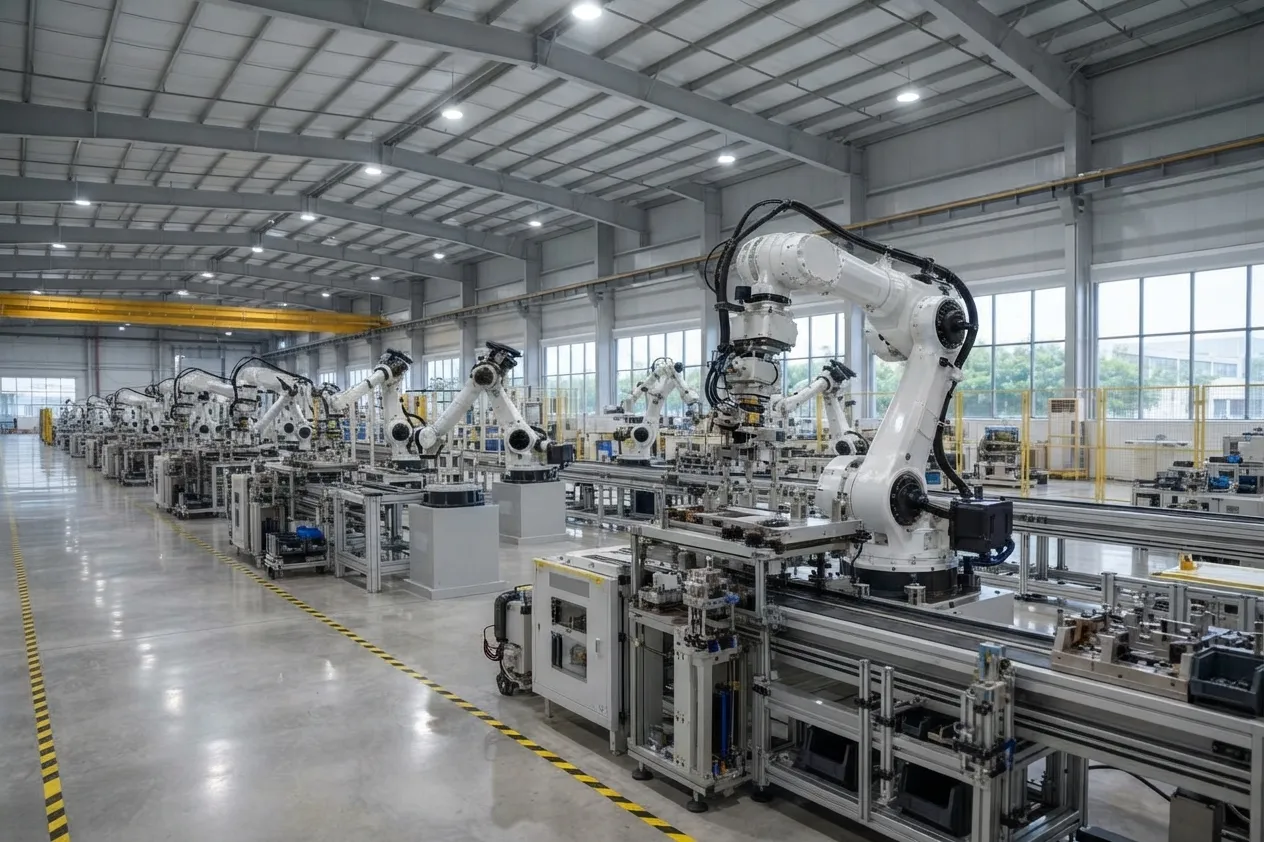
Industrial robotic arms require highly precise mechanical and electronic components. These include precision motors, gears, drives, controllers and other specialized components that must meet demanding accuracy and reliability standards.
Pakistan currently has limited domestic suppliers capable of producing many of these critical components at the required industrial standards.
This means that even when Pakistani engineers can design or assemble a robotic system, manufacturers may still need to import key components.
For the robotics industry to become truly localized, Pakistan would need to develop an ecosystem capable of producing these components domestically.
Why China Could Play an Important Role
China has developed one of the world's major manufacturing and industrial automation ecosystems, making cooperation between Pakistani and Chinese companies potentially valuable.
Rather than attempting to immediately produce every component locally, experts believe Pakistan could adopt a gradual approach.
The first stage could focus on local assembly and integration of industrial robots.
The second stage could involve greater participation by Pakistani engineers in robot design, programming, maintenance and customization.
The third stage could gradually shift toward producing critical components domestically.
Joint laboratories could also provide an environment where Pakistani and Chinese engineers and researchers work together on robotics technologies while developing local technical expertise.
Training Pakistani Engineers
Technology transfer is another important part of developing a domestic robotics industry.
Dr Awais Yasin, who completed his robotics PhD in Beijing and currently teaches at the National University of Technology in Islamabad, has emphasized the importance of training Pakistani engineers alongside Chinese specialists.
Such cooperation could help Pakistani engineers gain practical experience in areas including:
- Industrial robot design
- Robotics programming
- Machine vision
- Artificial intelligence
- Precision engineering
- Motion control
- Automation systems
- Robot maintenance
- Industrial integration
Developing this workforce would be essential if Pakistan wants to move beyond importing robotic equipment toward designing, assembling and eventually manufacturing its own systems.
Textile Industry Could Be a Major Testing Ground
Pakistan's textile industry could become one of the most important markets for industrial robotics and AI.
The textile sector generated approximately $17.88 billion in exports during the last fiscal year, accounting for around 56% of Pakistan's merchandise exports, according to the figures cited in the report.
This makes improvements in productivity, quality control and automation particularly important.
AI-powered inspection systems could help textile manufacturers detect defects, verify orders and improve quality consistency.
Robotic systems could eventually be used for additional tasks across manufacturing facilities, including material handling, packaging, assembly and other repetitive industrial processes.
Greater automation could also help Pakistani manufacturers meet increasingly demanding international quality and efficiency standards.
From Imported Technology to Local Innovation
Pakistan's long-term objective should not simply be to import more robots.
The larger opportunity lies in developing a complete domestic industrial automation ecosystem.
That ecosystem could include:
Local robotics companies → component manufacturers → software developers → AI specialists → engineering universities → industrial users → research laboratories
Once these areas begin working together, Pakistan could gradually reduce its dependence on imported robotics technology.
Local manufacturing could also create opportunities for Pakistani companies to eventually export robotics solutions to other emerging markets.
Challenges Ahead
Despite the potential, several challenges remain.
Pakistan would need investment in precision manufacturing, research and development, engineering education and industrial infrastructure.
Manufacturing high-precision components also requires advanced machinery and quality-control systems. Companies would need access to financing and long-term industrial partnerships to scale production.
There is also a need for stronger cooperation between universities, research institutions and private-sector manufacturers.
Without such collaboration, individual companies may find it difficult to develop the entire ecosystem independently.
A Potential New Chapter for Pakistan's Manufacturing Sector
The push for Pakistan-China cooperation in robotics comes at an important time.
Artificial intelligence and automation are rapidly changing global manufacturing. Countries that successfully integrate these technologies can potentially improve productivity, reduce production errors and compete more effectively in international markets.
Pakistan already has a growing pool of engineers, software developers and technology entrepreneurs.
The next step is connecting this human capital with advanced manufacturing capabilities.
Robionix Technologies' locally assembled AI inspection system demonstrates that Pakistani companies can develop practical industrial technology. The bigger challenge—and opportunity—is building the ecosystem required to manufacture increasingly sophisticated machines domestically.
Conclusion
Pakistan's ambition to manufacture industrial robots locally will not happen overnight. It will require technology partnerships, investment, research, skilled engineers and a strong component-manufacturing base.
However, cooperation with Chinese partners could provide a practical starting point.
Beginning with joint laboratories, local assembly and integration, Pakistan could gradually move toward manufacturing critical robotics components and eventually complete industrial robots.
For a country whose exports remain heavily dependent on manufacturing sectors such as textiles, the adoption and development of AI, robotics and automation could become an important part of Pakistan's industrial future.
The question is no longer simply whether Pakistan can use robots—it is whether Pakistan can build the ecosystem needed to manufacture them.