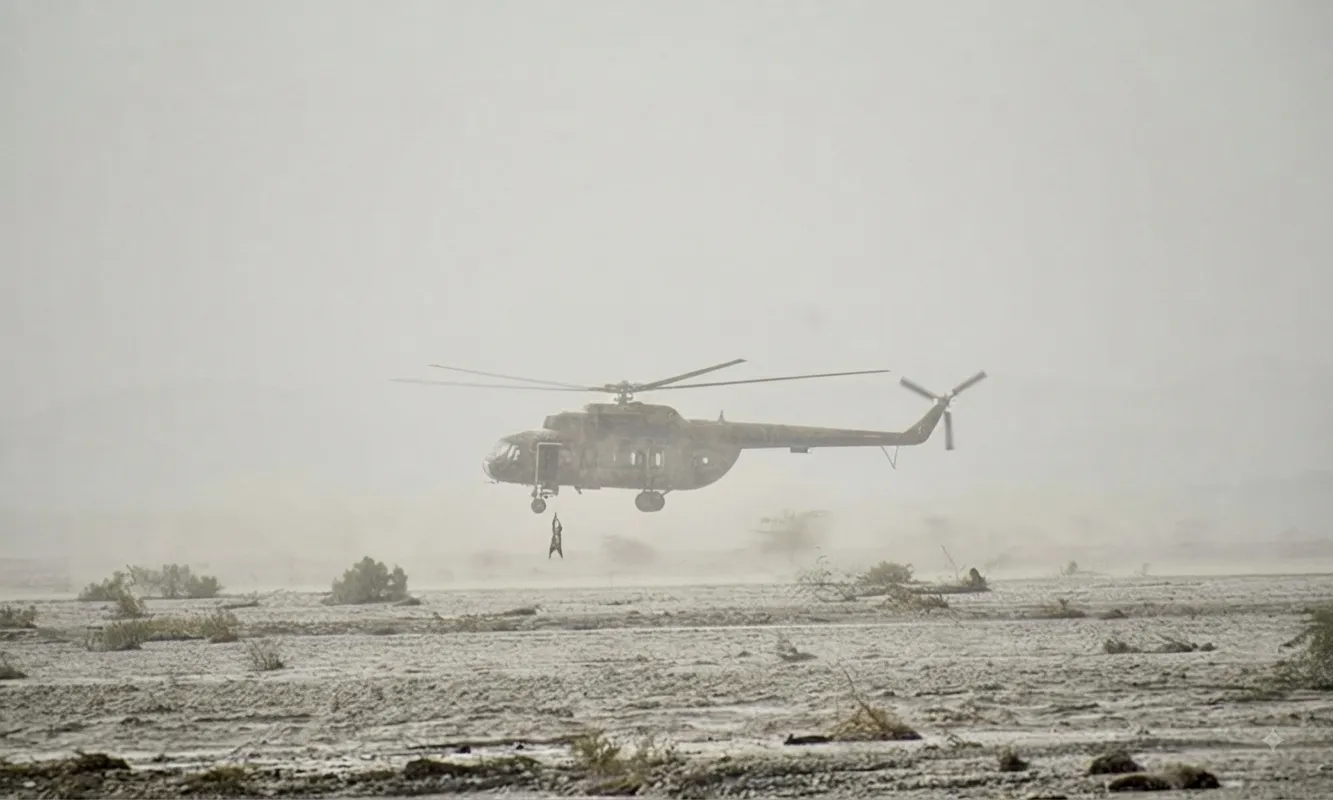
Official documents have revealed that the Punjab government spent Rs. 160 million on privately hired helicopters for rescue and relief operations during the 2025 floods. While the deployment itself was part of an emergency response, the Punjab Finance Department has since raised significant concerns over how the payment for these services was processed and verified.
The Helicopter Deployment
According to official records, the helicopters were hired from private operators and used over a 17-day period, from August 28 to September 13, 2025, coinciding with major flood rescue and relief operations in the province. During natural disasters of this scale, helicopters often play a critical role — reaching stranded communities, delivering emergency supplies, and evacuating people from areas cut off by floodwaters where road access is impossible.
Given the urgency of the situation, the Punjab government engaged private helicopter services under emergency procurement provisions — a standard and generally accepted practice during disaster response, when time constraints make lengthy competitive bidding processes impractical.
The Concerns Raised by the Finance Department
While the use of emergency procurement itself was permitted and not in question, the Punjab Finance Department has flagged several issues surrounding how the resulting payment of Rs. 160 million was processed:
1. An eight-month delay in processing payment The payment for helicopter services rendered during the flood response was not processed until eight months after the operations concluded — a significant gap that has drawn scrutiny.
2. Lack of independent verification of flying hours The Finance Department noted that the flying hours billed by the private helicopter operators had not been independently verified. Since payments for helicopter services are typically based on the number of hours flown, the absence of independent confirmation raises questions about whether the billed amounts accurately reflect the actual services provided.
3. No market-based assessment of rates charged There was reportedly no comparison of the rates charged by the private operators against prevailing market rates for similar helicopter services. Without this benchmark, it becomes difficult to determine whether the province paid a fair and reasonable price for the services rendered.
4. Possible tax liabilities under review Officials are also reviewing whether there are any outstanding tax liabilities connected to the payments made to the private helicopter operators — an additional layer of financial scrutiny being applied to the transaction.
What Happens Next
Despite these concerns, authorities have clarified that the use of emergency procurement itself was permitted under the circumstances — the flood response was, after all, a genuine emergency requiring urgent logistical support. The issue at hand is not whether helicopters should have been hired, but rather how the resulting payment has been documented, verified, and processed after the fact.
As a result, the relevant authorities have been directed to:
- Provide proper documentation supporting the billed flying hours and services rendered
- Conduct or facilitate independent verification of the hours claimed by the operators
- Establish whether the rates charged align with market norms for similar services
- Resolve any outstanding tax matters connected to the payments
Only once these steps are completed is the payment expected to be fully regularized.
Why This Matters
1. Emergency spending still requires accountability This case illustrates an important principle in public financial management: even when emergency procurement is justified — as it typically is during natural disasters — the resulting payments still require proper documentation, verification, and oversight after the fact. Urgency during a crisis does not eliminate the need for accountability once the immediate emergency has passed.
2. The risk of inflated billing in emergency contracts Emergency procurement processes, by their nature, often bypass standard competitive bidding and rate-verification mechanisms in order to respond quickly. This creates an inherent risk that billed amounts may not reflect fair market value unless verified retroactively — which is precisely the gap the Finance Department appears to be addressing in this case.
3. Delayed payments and their implications An eight-month delay in processing a Rs. 160 million payment is notable in itself, potentially reflecting either administrative bottlenecks or the additional time needed to properly review the claims before payment — though the exact reasons behind the delay have not been detailed in available reports.
4. Public trust in disaster relief spending Given that flood relief and rescue operations often involve public funds allocated during moments of crisis and public sympathy, ensuring that spending is properly verified and documented is important for maintaining public trust in how disaster relief resources are managed.
Conclusion
Punjab's Rs. 160 million expenditure on private helicopters during the 2025 flood relief operations highlights the tension between the need for rapid emergency response and the equally important need for financial accountability once the crisis has passed. While the helicopters played a valuable role in rescue and relief efforts over those critical 17 days, the Finance Department's review signals that proper verification and documentation — even for emergency expenditures — remain essential before public funds are fully released and regularized.
Disclaimer: This post is for informational purposes only and is based on publicly available reports. The image referenced in the original social media post is AI generated and is for reference only.